

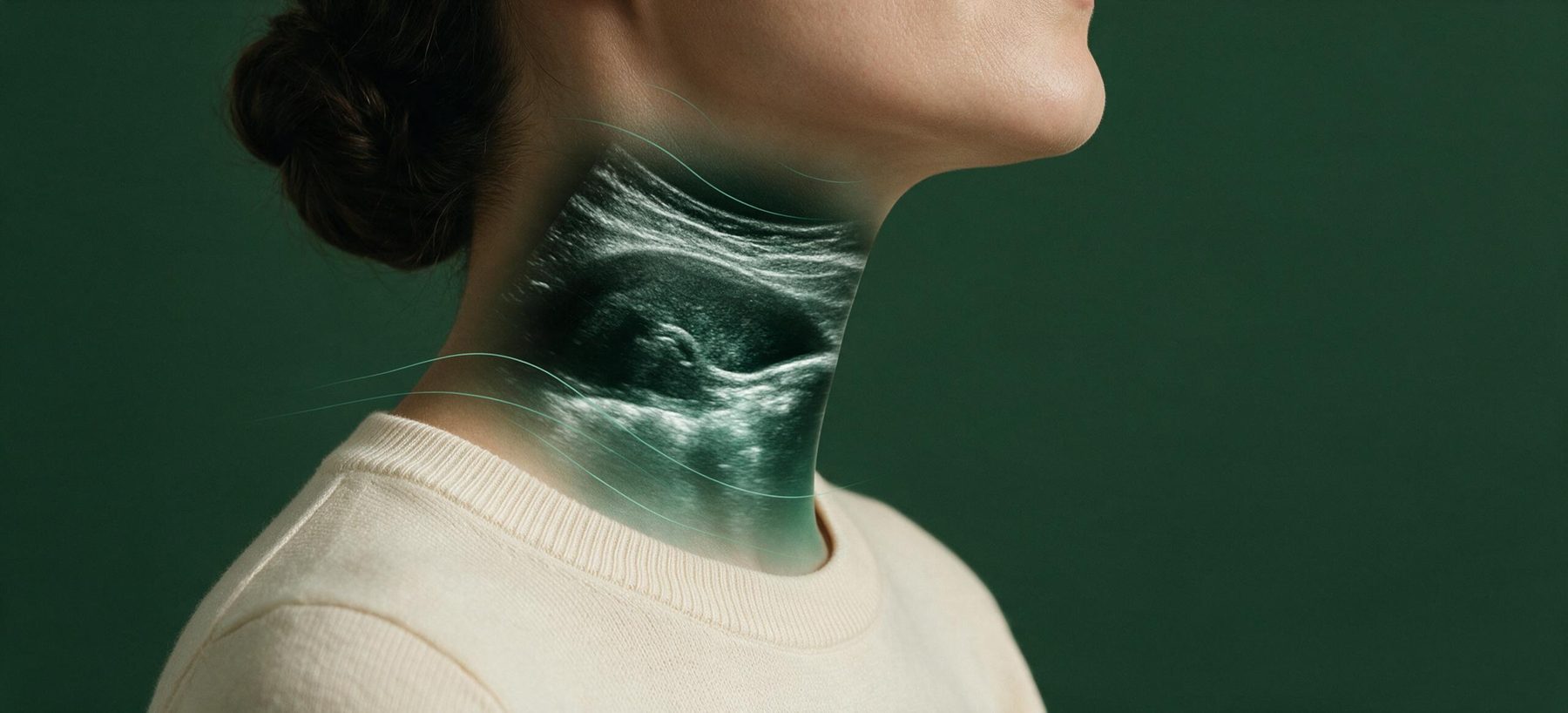
If you have had a thyroid ultrasound, your report almost certainly gives each nodule a score. It might be called a TI-RADS score, a U-classification, or simply a grade. It looks like jargon, but the idea behind it is simple: it turns what the radiologist saw into an objective number, so the recommendation that follows is consistent rather than a matter of opinion.
of thyroid nodules are benign
View as table
| Statistic | Value |
|---|---|
| of thyroid nodules are benign | ~95% |
Source: British Thyroid Association guidance; NHS patient information.
01Why thyroid nodules are graded
Thyroid nodules are extremely common. Around half of all adults have at least one by the age of sixty, and the overwhelming majority are entirely harmless. If every nodule were sampled, thousands of people would have needles put into their necks for no benefit at all. Grading exists to focus attention where it is genuinely useful.
The grade is not a diagnosis. It is a way of deciding, consistently, which nodules deserve a closer look.
Dr Husam Wassati, consultant head & neck and neuroradiologist
02What the radiologist is looking at
The score is built from a handful of features, each visible on the scan:
- Composition: whether the nodule is fluid (a cyst), solid, or a mixture. Purely fluid nodules are almost always benign.
- Echogenicity: how bright or dark the nodule appears compared with the surrounding gland.
- Shape: whether it is wider than it is tall, or the reverse.
- Margins: smooth and well-defined, or irregular.
- Calcification: tiny bright specks within the nodule carry more weight than coarse calcification.
- Size: which, combined with the features above, decides the threshold for sampling.
03What the grades mean in practice
Different systems number their categories differently, but they follow the same logic, from benign at one end to highly suspicious at the other. In plain terms:
- Benign or very low suspicion: no further action, or a routine review interval. This is the most common outcome by a wide margin.
- Low or intermediate suspicion: usually a follow-up scan after a set interval, with sampling only if the nodule is large or changes.
- High suspicion: a fine-needle aspiration is recommended, which is a quick outpatient test rather than an operation.
Whatever your grade, the recommendation is written into your report. You should never have to work out what happens next for yourself.
04Why growth matters as much as grade
A nodule that has grown meaningfully between two scans earns attention even if its features looked reassuring the first time. This is why measurements are recorded so precisely, and why keeping your previous reports is genuinely useful: comparison is often more informative than any single scan.
05What to expect from a thyroid ultrasound
The scan is painless and radiation-free, uses no needles unless a sample is agreed separately, and needs no preparation or fasting.
- History and questions5 min
- The scan12 min
- Findings and plan5 min
View as table
| Part of the visit | Typical time |
|---|---|
| History and questions | about 5 minutes |
| The scan | about 12 minutes |
| Findings and plan | about 5 minutes |
- 1
Before the scan
No fasting and no preparation. Wear something with an open neckline and leave necklaces at home.
- 2
During the scan
You lie back with your head tilted slightly. Warm gel and a small probe are moved over the front of your neck, and you can talk throughout.
- 3
After the scan
The findings and the grade are explained on screen, the next step is agreed, and your report is published the same day.
06What happens next
If a nodule has been found and you are unsure what your report means, a scan with a specialist who talks you through it is usually the fastest route to peace of mind. Most people leave knowing their nodule needs nothing more than a sensible review date.