Organ Scans
Vascular
Upper Limb
Lower Limb & Spine
Procedures
Body & Organs
Every scan, MRI, CT and injection, type a body part or a service name.
Muscles & joints · ProceduresInjection
Tennis or golfer’s elbow making it painful to grip, lift a kettle or work at a keyboard? A consultant scans your elbow first, then places a steroid or PRP injection precisely at the damaged tendon, under ultrasound guidance, in the same visit.
Medically reviewed by Dr John Fitzpatrick, consultant radiologist: GMC-registered · Last reviewed October 2026
£525
steroid injection, all fees inclusive
Scan first, same visit
diagnosed before anything is injected
Ultrasound-guided
needle placed under live imaging
No GP referral
book directly
Consultant Radiologist
scans and injects you personally
Self pay
and insurance accepted
Conditions we treat
The scan shows the tendon itself: how thickened or torn it is, and whether it has new blood vessels, which helps choose the right treatment.
Tennis elbow
Pain on the outer elbow from the common extensor tendon (lateral epicondylitis), worse when gripping or lifting.
Golfer’s elbow
The same problem on the inner elbow (medial epicondylitis), from the tendons that bend the wrist.
Stubborn, long-standing tendon pain
Elbow pain lasting months despite rest and physiotherapy, where PRP is often the preferred option.
Olecranon bursitis
A swollen bursa at the point of the elbow, drained under ultrasound where it helps.
Elbow joint arthritis
Pain and stiffness inside the joint, eased with a steroid injection into the joint.
Partial tendon tears
Seen clearly on ultrasound, guiding whether an injection, rest or a surgical opinion is right.
Treatment options and prices
Both have a place. Steroid works faster but may not last; PRP is slower but aims at healing. Your consultant advises after the scan.
fast short-term relief
£525
All fees inclusive, diagnostic scan included
your own platelets
£545
Blood draw, preparation and guided injection in one visit
Read more about PRP injections →
Consultant-led treatment
Your elbow injection is performed by a consultant musculoskeletal radiologist from a leading London hospital. They scan the tendon first and show you on the screen what is damaged, then guide the needle to that exact spot under ultrasound guidance, so the treatment reaches the tendon rather than the tissue around it.
Diagnosed on ultrasound before anything is injected
if an injection is not right for you, it does not go ahead
Needle placed under ultrasound guidance
placed exactly where the problem is, not by feel
Formal report and images on your personal health portal
usually the same day, ready to share with your GP or physiotherapist
Onward referral to other tests and specialists when required
to physiotherapy, MRI or an upper-limb surgeon where appropriate
Included in the price
Prices by treatment, all fees inclusive
If the scan shows an injection is not the right treatment, it does not go ahead and our standard diagnostic ultrasound rate applies. Most major private insurers accepted; we are currently unable to accept AXA or Aviva policies.
Pricing & what’s included
£525steroid injection
Meet your consultant
Who treats you matters. Tennis elbow injections given by feel often land in the tissue around the tendon. At the Harley Street Ultrasound Group your elbow is assessed, scanned and injected by a consultant musculoskeletal radiologist, the senior doctors who image and treat tendon injuries for the NHS every day.
Dr John Fitzpatrick
Consultant radiologist
Musculoskeletal and trauma imaging, image-guided injections
Dr Niels van Vucht
Consultant radiologist
Musculoskeletal subspecialist, RNOH fellowship in image-guided intervention
Dr Nikhil Patel
Consultant radiologist
Musculoskeletal imaging and ultrasound-guided injections, King’s College Hospital
Dr Shayan Ahmed
Consultant radiologist
Musculoskeletal imaging, Urological imaging, General ultrasound
All our doctors are GMC-registered. Meet the whole team →
Three ways to reach us
01
Use our easy and hassle-free booking platform to make an appointment and get a confirmation in seconds.
Book online02
Do not hesitate to reach out by writing to us. Use our online form to send us your queries.
Send a message03
If something is unclear, give us a call directly to discuss our services.
0203 904 4441What happens on the day
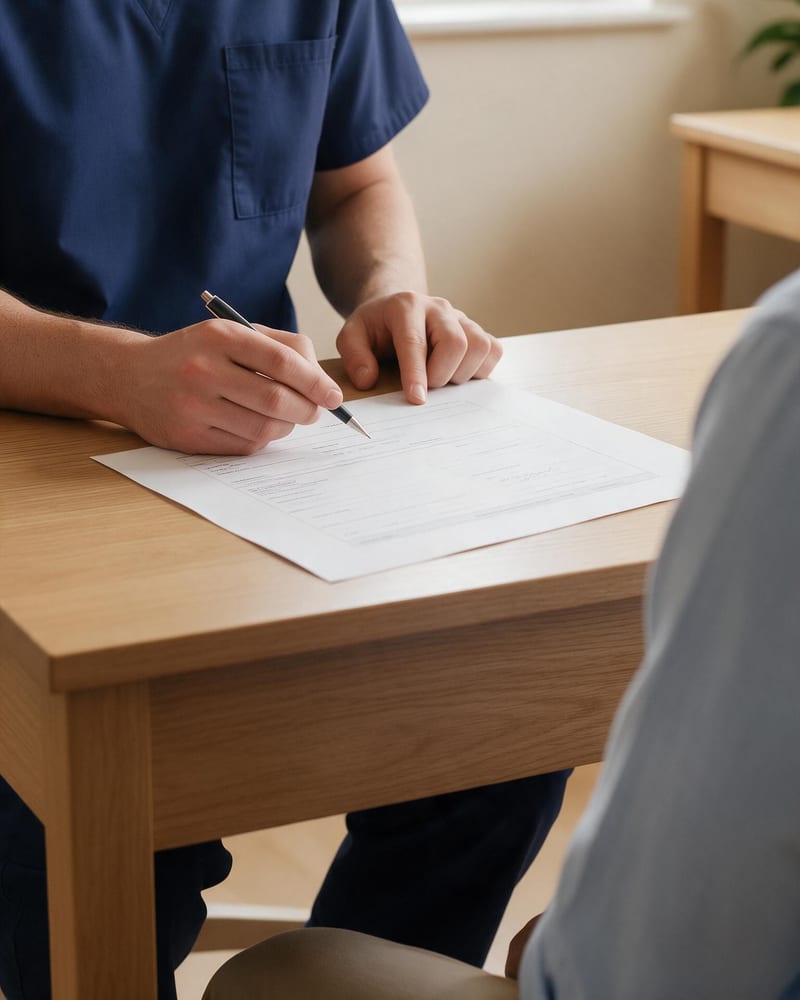
Your consultant asks where it hurts, what makes it worse, what you have tried and what you want to get back to, and examines your elbow.
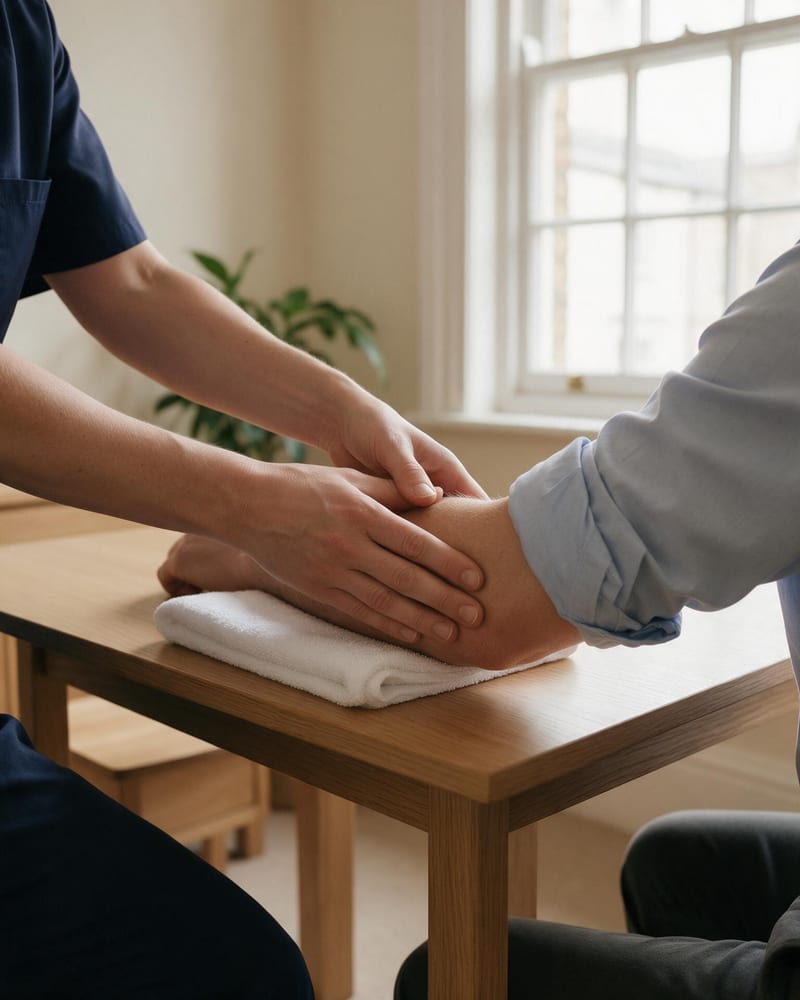
You sit with your arm resting on a support while warm gel and a probe show the tendon attachments on the outer and inner elbow, the joint and the bursa. The damage is measured and other causes of elbow pain are ruled out.
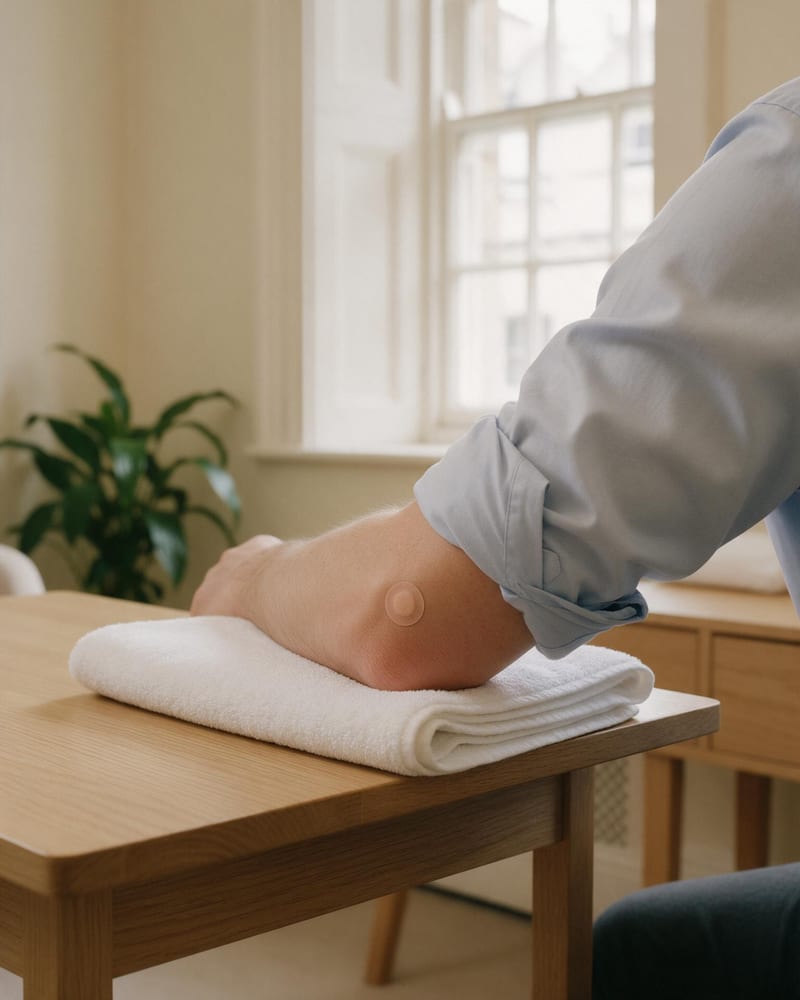
The skin is cleaned and numbed with local anaesthetic, then the needle is guided to the damaged part of the tendon under ultrasound guidance. For PRP, a small blood sample is taken and prepared first. Most people feel a sting, then pressure.
a few minutes under ultrasound guidance
You leave with written aftercare: rest the arm from heavy gripping and lifting for 48 hours (a few days after PRP), then start the loading exercises you are given. Your report is on your portal the same day.
Risks, honestly, and aftercare
Serious complications: infection, an allergic reaction, damage to a tendon, are rare, and rarer still under ultrasound guidance. These are the common ones, by agent, so nothing surprises you.
Rest the joint, ice for ten minutes at a time, and avoid strenuous activity. Mild soreness is normal; paracetamol is fine.
Return to normal activity gradually. Your consultant tells you when relief should begin for your agent, and we call to check in.
Increasing pain, heat, redness or fever after the first two days. Call 0203 904 4441 the same day. Out of hours, contact 111.

Preparation
A short questionnaire before you attend
A pre-procedure questionnaire is sent with your booking confirmation: medication, allergies, blood thinners and diabetes. Please complete it before your appointment.
Eat and drink normally
There is no fasting. Bring a list of your medication, and tell us if you take blood thinners.
Wear a short-sleeved or loose top
So the area can be scanned and injected easily; a gown is available.
Having PRP?
Avoid anti-inflammatory painkillers such as ibuprofen for a week before and after, and drink plenty of water on the day.
Arrive five minutes early
99 Harley Street, W1G 6AQ: a short walk from Regent’s Park and Oxford Circus stations.
Questions, answered
Anything else? Call 0203 904 4441, a real person answers, and a clinician can call you back.
A tennis elbow injection places medication at the common extensor tendon on the outer elbow, where the damage that causes tennis elbow sits. It is usually a steroid with local anaesthetic, or PRP made from your own blood. Here it is placed under ultrasound guidance after a diagnostic scan of the tendon.
It usually eases pain quickly, often within days. But research shows the benefit in tennis elbow is often short-lived, and the pain can be more likely to return later than with exercise alone. It can be useful to settle severe pain so you can start rehabilitation, and your consultant will discuss the trade-off honestly.
Tennis elbow is one of the conditions where PRP has been studied most, and several trials suggest it can give longer-lasting improvement than steroid for chronic cases. The evidence is still developing and it does not help everyone. Improvement builds over several weeks, alongside a loading exercise programme.
Steroid works faster but tends to wear off. PRP works more slowly but aims to support healing, and is often preferred for tennis elbow that has lasted several months. Your consultant recommends one after seeing the tendon on the scan and hearing how long it has lasted.
Golfer’s elbow behaves much like tennis elbow on the inner side of the elbow. A steroid injection can ease pain in the short term, and exercises are the foundation of long-term recovery. Ultrasound guidance matters here, as the ulnar nerve runs close by.
Most people find it manageable. Local anaesthetic numbs the area, so you feel a sting, then pressure. The elbow often aches for a day or two after a steroid injection, and for two to three days after PRP.
The local anaesthetic can ease pain within minutes, then wears off after a few hours. The steroid usually starts working within a few days. PRP is slower: improvement builds over four to twelve weeks.
A steroid injection often helps for several weeks. PRP can give improvement lasting many months when combined with exercises. Most tennis elbow eventually settles, often within a year, and treatment aims to make that time easier.
Many people need just one, and some benefit from a second injection a few weeks later. Your consultant reviews your progress and only recommends another if it is likely to help.
Avoid heavy gripping, lifting and racket sports for 48 hours after a steroid injection, or a few days after PRP. Then start the loading exercises you are given and build up gradually. Use paracetamol rather than ibuprofen for soreness if you have had PRP.
Rarely. Most cases settle with time, activity changes, exercises and, where needed, an injection. Surgery is usually only considered when symptoms have lasted six to twelve months or more despite good treatment. Your consultant can refer you to an upper-limb surgeon if that point is reached.
At Harley Street Ultrasound a steroid injection for tennis or golfer’s elbow is £525 and a PRP elbow injection is £545, all fees inclusive: the consultant assessment, diagnostic ultrasound, the guided injection and your written report.
We will never give you an injection you do not need. Every appointment starts with a diagnostic ultrasound of your elbow, and if your consultant decides an injection is not the right treatment, it simply does not go ahead. You are charged our standard diagnostic ultrasound rate, not the treatment price.
You still leave with a clear plan: physiotherapy, a different treatment, an MRI, or a referral to the right specialist, with your report and images on your secure portal.
No. Harley Street Ultrasound is a private clinic, so you can book an ultrasound-guided elbow injection in London directly, online or by phone: no GP letter and no waiting list. If you are searching for elbow injections near me in central London, we are at 99 Harley Street, a short walk from Regent’s Park and Oxford Circus stations.
Prices are published before you book and are all fees inclusive: the consultant assessment, the diagnostic ultrasound, the guided injection, local anaesthetic and your written report. Insured patients should check with their insurer and bring an authorisation number if their policy requires one.
Yes. Your consultant explains the scan findings and the treatment in the room, and a written report with your images is published to your secure patient portal, usually the same day, ready to share with your GP, physiotherapist or surgeon.
Usually, yes: there is no sedation or general anaesthetic. The local anaesthetic can leave the area numb for a few hours, so if the injection is in your right leg or foot, or the joint feels weak, it is sensible to arrange a lift or take public transport.
Yes: completely. Coming to us privately never affects your NHS care. Your report and images can be shared with your NHS GP or consultant, and if anything needs onward NHS care, your consultant writes to your GP so you re-enter the pathway with a diagnosis already in hand.

Private elbow injections
£525 steroid injection
What patients say
“Very friendly staff. Everything was explained to me in detail. They took the time to listen to me and answer my questions. Thank you Harley Street.”
“Excellent service from the Consultant and the entire team at 99”
“Perfect service with incredible attention to detail and empathy. Welcoming, comfortable surroundings and a service that exceeded expectations.”
Related
Every service has one page and one fixed price. If you are not sure which is right, call us and a clinician will advise before you book.
Ready when you are
Same-day and next-day appointments at 99 Harley Street. No GP referral needed, results explained before you leave.
This assistant answers questions about this website only and is not medical advice. In an emergency call 999.